Wednesday, April 9, 2014

The Best Paying Aviation Maintenance & Engineer Jobs

0 comments
When it comes to choosing a career path, it is extremely important to choose one that will not only reward you with the highest possible salary and best job benefits, but also has the best chance of remaining relevant in the world for years to come. You don’t want to hitch your star to an industry which is all but guaranteed to disappear in a few years.


Choosing A Career That You Can Prosper In Is Of Superior Importance

With the dawn of the international age of modern technology, the 21st century is rife with thousands of new career opportunities in as many fields of labor. Some of these fields are destined to provide a lifetime of excellent pay and benefits, while others are destined to become obsolete. It is vitally important that you choose the path which is not only right for you, but also able to supply a long and rewarding career.

Pursuing A Career In The International Aviation Industry

So, when you are deciding which career to pursue, you should certainly keep in mind that the international aviation industry is one that continues to grow by leaps and bounds. This is one industry that is guaranteed not to be made obsolete by new social, political, and technological developments. In fact, all of these developments are contributing to making the international aviation industry more relevant than ever. This is especially true in areas such as Southeastern Asia and the Middle East, where positions in the aviation industry are being created faster than employees are appearing to fill them.

Thousands Of Maintenance And Engineer Positions Are Available

One of the areas in which the modern international aviation industry is finding itself most in need is maintenance and engineer positions. These are extremely important positions which thousands of applicants from all over the world are now being invited to fill. The need for international employees is so great that salary offers are being made which are far in excess of anything a newly employed engineer could expect to receive as an offer from an airline in their own country.
The following is a list of some of the highest paying aviation maintenance and engineer jobs. These are only some of the positions you can apply for, so be sure to always check the listings published by international airlines and airports.

Systems Engineer (NAV ERP–Technical)

One of the very best paying jobs that a new employee could hope to net in the rapidly growing international aviation industry is that of a Systems Engineer. This is a particularly lucrative position if you have expert knowledge of the Dynamics NAV (ERP) and LS Hospitality applications. Regions of the world, such as Southeastern Asia and the Middle East, are in dire need of systems engineers who can easily operate these vital software programs.
Engineers who occupy this position are normally placed in charge of not only operating and maintaining these programs, but also in charge of ensuring their continued viability and suggesting any needed improvements. This may include devising new program requirements, such as running tests to ensure efficiency, as well as “worst case scenarios” designed to anticipate any potential future system malfunctions or failures.
Engineers who can successfully navigate NAV (ERP) and LS programs, with all of their attendant applications and developments, are currently earning between $55,000 and $75,000 USD in the United States and other Western countries. With the corresponding increase in salary which employment in the same job currently conveys, an engineer working in Southeastern Asia or the Middle East could earn a possible $75,000-85,000 USD.
To be considered as a viable candidate for this position, you will need to be in possession of a Bachelor’s degree (or its international equivalent) in a field such as Engineering, Computer Science, or Mathematics. You will also generally to show proof of several years of employment experience in fields that involve the maintenance of NAV(ERP) and LS programs.

Flight Engineer

If you possess excellent engineering qualifications and experience, you may wish to consider getting out of the office and up into the friendly skies. Becoming a Flight Engineer will certainly put you on the flight path to rapid promotion, excellent pay, and top notch company benefits.
If you have the requisite qualifications for the job, you can become a Flight Engineer. The responsibilities entail maintaining, running, and repairing all elements of the technology found aboard the airplane during its time in the air. This position is different from that of an airplane mechanic, as it deals mostly with computer technology rather than the actual machinery that powers the craft.
To qualify for this position, you will need to possess a FAA, EASA, CAAC or HKCAD licenses. There will also be a flight training course to familiarize the new employee with the rigors and responsibilities of performing the tasks of their job while in the air. The position is best for an individual who is adept at multi-tasking.
The position of Flight Engineer is one that usually carries a median salary of between $60,000-$75,000 USD in most Western countries. The exact level of salary and benefits offered will depend on the extent of your qualifications and experience in the field. A Flight Engineer who gains employment with an airline operating out of Southeastern Asia or the Middle East can expect to earn between $70,000 and $90,000 USD.

Senior Manager Solutions Design Engineer

The position of Senior Manager Solutions Design Engineer is one that is perfect for engineers who possess a decade or more of hard experience in the industry. As the title implies, this is a high level manager position, and is not advisable for those who have no experience in employee management as well as technological maintenance.
The responsibilities entailed by this position will normally include not only supervising the activities of the engineering department, but also being in charge of all of the design, maintenance, repair, and long range improvement strategies which the employer will desire to see implemented. This means that the Senior Manager Solutions Design Engineer will be responsible for the introduction of short and long range industry concepts, as well as making expert recommendations concerning the technology which is appropriate to supplement their introduction.
As this is a high level management position, the qualifications and proof of experience required to apply for this job will be correspondingly higher than for most other readily available management and engineering positions. Most employers will require a Master’s degree or its international equivalent. Ten or more years of experience in engineering, maintenance, and management will be expected.
The level of salary that a newly hired Senior Manager Solutions Design Engineer can expect will vary depending on how much experience and qualifications they possess. In the United States and other Western countries, the expected salary will usually range between $65,000 to $75,000 USD. However, in regions of the world which are starving for highly experienced and qualified senior engineers, such an individual may well receive an offer that ranges between $80,000 to $90,000 USD.

Technical Service Engineer

A Technical Service Engineer is an individual who is qualified to perform vital engineering and maintenance tasks such as those that generally associated with the development and technical support of aircraft structural systems, and other associated areas such as propulsion and avionics systems. The Technical Service Engineer will also normally maintain control of all elements of the design of maintenance software and documents which are produced within their division.
In addition to design maintenance, the Technical Service Engineer will generally be the final authority on approval of all new document and software designs that are created within their specific division. This individual will also be responsible for conceiving and carrying out regular routine checks on all of the associated technology, with regard to its continuing efficiency and viability over a long range period.
Applicants who apply for the position of Technical Service Engineer should be in possession of a Bachelor’s degree (or its international equivalent) in such subjects as Mechanical, Electrical, or Aeronautical Engineering. You should have between three and five years of experience working in the field of Technical Service Engineer for an airline in your country of origin.
The salary for a fully experienced and qualified Technical Service Engineer will vary according to the amount of qualifications possessed by the individual who applies for the position. The normal salary can vary from $50,000 to $60,000 USD in the United States or most Western countries. However, in regions of the world such as Southeastern Asia and the Middle East, where the need for individuals to fill this position is at its greatest, the expected salary can range from $60,000 to $70,000 USD.

Many Entry Level Positions Are Available In The Aviation Industry

In addition to the positions listed above, there are a great many other opportunities currently on offer within the international aviation industry which involve entry level positions. For example, positions such as Flight Quality Control Expert are available from many international airlines, especially in regions of the world such as the Middle East and Southeastern Asia, which require many such positions to be filled.
These entry level maintenance and engineer jobs will usually require little more than a Bachelor’s degree (or its international equivalent) in the applicable field. A few of them will require certification from the FAA or other international industry regulation authorities. For individuals who are self starters, adept at multitasking, and able to travel to foreign countries in search of maximum career opportunities, these positions are ripe for the taking.

Which Personal Qualities Are Required To Pursue These Positions?

The individual that chooses to pursue a career in the modern international aviation industry needs to be a person that can handle the inevitable stress and tension that comes from working in a foreign land, far from their friends and loved ones. If you achieve a position with a company that is based in Southeastern Asia or the Middle East, you will inevitably spend the bulk of your time in these regions.
A person who works under these conditions should also possess excellent communication and language skills in English, as well as the ability to become familiar with the language of their host country. Good public etiquette skills are also a must. Above all, you should possess an adventurous spirit, and an ability to adapt to changes. Not only do these positions offer excellent salary and benefits packages, but they also afford one the opportunity to travel all over the world and gain experiences and knowledge that few others will ever have the chance to obtain.

aviation jobs asia

Tuesday, April 8, 2014

Saudi Prince's $500 Million Airbus A380 Will Blow Your Mind

0 comments
When people who are just a little bit rich travel, they fly first class. When you're really rich, you rent a private jet. When you're insanely rich, you fly on your very own private jet with your name painted on the wings. When you are a multi-billionaire Saudi Prince, you fly on a mind blowingly lavish $500 million customized Airbus A380. Recently it was revealed that Saudi Prince Alwaleed Bin Talal, who has a net worth of $18 billion, purchased a $300 million Airbus A380 and is spending an additional $200 million remodeling the plane into a flying palace that makes Airforce One look like a hunk of junk….

Prince Alwaleed Bin Talal is one of the wealthiest people in the Arab world. Thanks to thousands of extremely shrewd investments, the Prince was able to turn a modest fortune into more than $18 billion. Through his investment firm Kingdom Holding, Prince Alwaleed has bought up large stakes in companies like News Corp, Apple, Citigroup, Twitter and more. He owns luxury hotels like The Savoy in London, the Fairmont in San Francisco, the Plaza in New York and the Four Seasons. He owns several yachts, more than 200 cars and three incredible palaces that cover a combined 5 million square feet. When Prince Alwaleed takes delivery of his $500 million Airbus, it will be one of four massive private jets. It will also be the largest and most expensive private plane in the world.


The base Airbus A380 costs $300 million and normally fits around 800 passengers. Prince Alwaleed's Airbus A380 is being completely stripped and remodeled with the following mind blowing luxuries:


  • One parking space for his Rolls Royce
  • Concert hall with grand piano, seating for 10 and stage for private entertainment
  • Marble tiled steam room with spa treatments
  • A "wellbeing" room complete with flat screen TVs on the walls and floors that shows passengers what they are flying over
  • Five master bedroom with king sized beds, private bathrooms and showers
  • 20 smaller private rooms
  • Private elevator that connects the master bedroom to the tarmac for quick entrances and exits
  • Boardroom with holographic monitors
  • A prayer room with computer monitored prayer mats that automatically adjust to face Mecca


Flight MH370: search teams racing against the clock to find black box

0 comments
Search teams are racing against the clock to find the missing Malaysia Airlines flight MH370 as the window for finding one of the black boxes with an active power source gets progressively smaller.

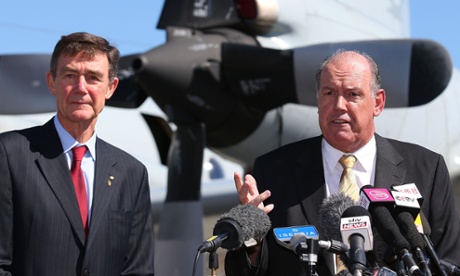
Australia’s defence minister, David Johnston, said on Tuesday that a spell of “reasonable” weather in the Indian Ocean search area meant the sea and air search teams would be stepping up their efforts in the next few days.

On Monday the Australian vessel Ocean Shield detected two separate pulses in the Indian ocean search area consistent with signals emitted by a black box. The first lasted two hours and 20 minutes and the second 13 minutes.

Johnston said 20 sonar buoys had been deployed in the search zone and 14 ships and 14 aircraft were also scouring the ocean where the doomed flight is believed to have disappeared 32 days ago, claiming the lives of all 239 passengers on board. Black boxes emit pulses for about 30 days.

“I want to confirm that we have at least several days of intense action ahead of us. The weather out there today is reasonable,” he said.

The head of Australia’s joint co-ordination centre, Angus Houston, said Ocean Shield was continuing to look for signals from the black box by towing a pinger. An underwater vessel would not be used unless the search area could be narrowed further.

“We will not deploy it unless we get another transmission, in which case we will probably get a better idea about what’s out there,” Houston said.

“If we can get more transmissions we can get a better fix on the ocean floor, which would enable a much more narrowly focused visual search.

“That’s why it’s so important to get another transmission and we need to continue until there is absolutely no chance that the devices are transmitting.”

China's state news agency Xinhua also announced this weekend that a Chinese patrol ship, the Haixun 01, detected a signal that could be from one of the black boxes of the missing plane, about 300 nautical miles from the location of Ocean Shield.

Houston said it was unlikely the Chinese and Australian crews had detected the same source, though he added: "In deep water funny things happen with acoustic signals."

Professor Charitha Pattiaratchi, an oceanographer from the University of Western Australia, said it was not unusual to detect the same signals at such lengths.

“The nature of sounds in the ocean is that they get refracted a lot and can go very long distances,” he said. “For example, we’ve detected off Rottnest Island sounds that are emanated from Antarctica. And in the 1960s they had an explosion in Bermuda that could be detected near Rottnest.

“The Chinese ship may be picking up a signal that is trapped in the surface layer. In deep water the Ocean Shield can go beyond the surface layer where the sound can be trapped, so they can get a more direct signal,” he added.

The guardian

Sunday, April 6, 2014

Pro-Russian protesters seized state buildings in three east Ukrainian cities

0 comments

Pro-Russian protesters seized state buildings in three east Ukrainian cities on Sunday, triggering accusations from the pro-European government in Kiev that President Vladimir Putin was orchestrating "separatist disorder".

The protesters stormed regional government buildings in the industrial hub of Donetsk and security service offices in nearby Luhansk, waving Russian flags and demanding a Crimea-style referendum on joining Russia.

Protesters also later seized the regional administrative building in Kharkiv, Ukraine's second largest city, Interfax news agency reported. All three cities lie close to Ukraine's border with Russia.

Interior Minister Arsen Avakov vowed to restore order in eastern Ukraine without using violence and also accused Ukraine's ousted president Viktor Yanukovich, whose political base was in Donetsk, of conspiring with Putin to fuel tensions.

"Putin and Yanukovich ordered and paid for the latest wave of separatist disorder in the east of the country. The people who have gathered are not many but they are very aggressive," Avakov said in a statement on his Facebook page.

"The situation will come back under control without bloodshed. That is the order to law enforcement officers, it's true. But the truth is that no one will peacefully tolerate the lawlessness of provocateurs."

Acting President Oleksander Turchinov called an emergency meeting of security chiefs in Kiev and took personal control of the situation, the parliamentary press service said.

Mainly Russian-speaking eastern Ukraine has seen a sharp rise in tensions since Yanukovich's overthrow in February and the advent of an interim government in Kiev that backs closer ties with the European Union.

Russia has branded the new government illegitimate and has annexed Ukraine's Crimea region, citing threats to its Russian-speaking majority - a move that has sparked the biggest standoff between Moscow and the West since the end of the Cold War.

REFERENDUM DEMAND

Around 1,500 people protested in Donetsk on Sunday before breaking into the regional administration building, where they hung a Russian flag from a second-floor balcony, a Reuters witness said. Protesters outside cheered and chanted "Russia! Russia!".

In the Luhansk protest, Ukrainian television said three people had been injured. Police could not confirm the report.

Talking to the crowd over a loudspeaker, protest leaders in Donetsk said they wanted regional lawmakers to convene an emergency meeting to discuss a vote on joining Russia like the one in Ukraine's Crimea region that led to its annexation.

"Deputies of the regional council should convene before midnight and take the decision to carry out a referendum," one of the protest leaders said, without identifying himself.

A local Internet portal streamed footage from the seized building, showing people entering and exiting freely. Soviet-era music was being played over loudspeakers outside.

The building houses the offices of Serhiy Taruta, a steel baron recently appointed by the interim government in Kiev as governor of a region with close economic and historical ties to Russia.

"Around 1,000 people took part (in the storming of the building), mostly young people with their faces covered," said Ihor Dyomin, a spokesman for Donetsk local police.

"Around 100 people are now inside the building and are barricading the building," he added.

In Luhansk, Reuters television showed images of hundreds of people outside the state security services building and a policeman in riot armor being carried away on a stretcher.

Ukrainian television said the Luhansk protesters were demanding the release of people detained by security services in recent days as well as a referendum on joining Russia.

"We don't want to join the EU, we don't want to join NATO. We want our children to live in peace," an unnamed woman told Ukraine's Channel Five in Luhansk.

Ukraine's state security services said on Saturday they had detained 15 people in Luhansk suspected of planning to overthrow the authorities and had confiscated hundreds of rifles, grenades and petrol bombs.

Pro-Russian demonstrators have held rallies in recent weeks in several eastern Ukrainian cities, not far from a border where Moscow has assembled tens of thousands of troops.

Reuters

Thursday, April 3, 2014

MH370 search: Crucial to improve aircraft tracking, says IATA

0 comments
KUALA LUMPUR: Malaysia's missing jet tragedy illustrates the needs to improve in-flight tracking of passenger aircraft, the International Air Travel Association (IATA) said on Tuesday,  adding: "We cannot let another aircraft simply vanish."

"MH370 has highlighted the need to improve our tracking of aircraft in flight," Tony Tyler, head of the airline industry trade body, said in a statement.

"In a world where our every move seems to be tracked, there is disbelief both that an aircraft could simply disappear and that the flight data and cockpit voice recorders are so difficult to recover."

Tyler's statement was released at an IATA conference in Kuala Lumpur, where baffled authorities are investigating what caused Malaysia Airlines flight MH370 to disappear on March 8.

The Boeing 777 vanished en route from Kuala Lumpur to Beijing with 239 people on board.

Malaysian authorities believe the flight was deliberately diverted by someone on board, flew for hours in the wrong direction, and was last detected by a satellite in the remote Indian Ocean.

"We cannot let another aircraft simply vanish," Tyler said.

Aviation experts say the MH370 mystery could prompt major change in the industry, particularly in improving the tracking of aircraft even if they slip off civilian radar and their automated signalling systems are disabled.

Malaysia says the missing jet's Aircraft Communications Addressing and Reporting System (ACARS) and its transponder cut out at around the time it disappeared from radar.

The systems relay information about the plane and its location.

A multi-nation search is under way for wreckage from MH370 in the Indian Ocean. It is hoped that the plane's "black box", with its flight data and cockpit voice recorders, can be recovered to provide clues on what happened.

AFP

Wednesday, April 2, 2014

Will Flight 370 Change the Future of Flying?

0 comments


On Tuesday, the International Air Transport Association (IATA) released a report that should have been received as good news by the flying community. In 2013, only 210 people were killed in commercial aviation accidents, nearly 50 percent fewer than the 414 casualties reported in 2012.

For context, 3 billion people flew safely in 2013, traveling on 36.4 million flights, meaning that we should logically feel pretty good about the state of flying in 2014. Yet for three weeks, the globe has been consumed by the mystery of Malaysia Airlines Flight 370, an air catastrophe that world's best international aviation experts have been unable to explain.

Though authorities have concluded that the plane crashed into the south Indian Ocean roughly six hours after it severed (intentionally or not) contact with ground control, nobody can figure out how, or why, the plane went down. And no physical trace of the missing Boeing 777 has been found. 

According to The Daily Beast's Clive Irving, "no accident in the history of aviation has so spooked people around the world." And, Irving continues, the tragedy struck during a time of rapid expansion for the airline industry: 

"This crisis has hit the airline industry at a time when there seemed to be no limits to its growth. Global air travel has increased at an average rate of between five and six percent per year, even in times of economic distress. Demand is highest in places like China and Southeast Asia, where sudden wealth is fueling the urge to travel to faraway places. Industry forecasters agree that by 2030 the Asia Pacific region will overtake both North America and Europe to become the largest aviation market, accounting for 32 percent of the total"

In order to win back some of the confidence that has built up over years of relative safety (consider that nearly 1.3 million people die in car accidents every year) the aviation industry will likely have to adopt some new standards in response to this latest tragedy. Even as they are still unsure what, if any, measures could have prevented it.

In tandem with its positive report on Tuesday, IATA said it is creating a task force to make recommendations on how to improve aircraft tracking by the end of the year. 
IATA General Director Tony Tyler said, "in a world where our every move seems to be tracked, there is disbelief that an aircraft could simply disappear. Accidents are rare, but the current search for 370 is a reminder that we cannot be complacent on safety," adding "we cannot let another aircraft simply vanish." 

Here's what could — or at least, should — change as a result of the unresolved fate of Malaysia Airlines Flight 370. 

Live-streaming flight data 

Last week, Joe Kolly, the research and engineering director for the U.S. National Transportation Safety Board (NTSB), said the group is examining live-streaming some flight data recorders, removing the need to search for a plane's black box in the event of a crash. According to Kolly, "You're looking for what is the most important information... We have our staff involved in technical meetings and discussions and working groups on just what type of data you would need... what are the rates at which those data need to be transmitted, [and] what is going to trigger the data download." 

According to CNN, the Canadian company Flyht Aerospace Solutions has a device that utilizes just this type of technology: 

"We would know where the aircraft has gone, where it is, and we would have information on what had happened in the meantime," [Flyht director Richard Haven] said. On a normal flight, the system would send updates every five to 10 minutes. It can be programmed to recognize when something is wrong, such as a deviation in flight path, and automatically begin streaming second-by-second data."

But the technology is expensive, about $100,000 per installation. However, Flyht officials say the service would save money over time. And other companies offersimilar technology for less. Still, Tyler believes that the switch could be too costly too be practical, asking, "To have every aircraft streaming all date at every phase of the flight, can it be managed or would it simply overwhelm us?" 

Better passenger screening 

As details on the passengers and crew of MH370 emerged, onlookers were surprised to hear that two flyers boarded with false papers. Though those turned out to be, in all likelihood, innocent immigrants seeking asylum in Europe, the fact that they were able to board at all is cause for concern. Tyler says that responsibility falls with individual governments. "It is important to remember that airlines aren't border guards or policemen." He added, "Whether or not there is a security dimension to this tragedy, that two passengers could board an aircraft with fake passports rings alarm bells." 

According to the Wall Street Journal, Malaysia has said that it will look into their airport safety practices: 

"Malaysian authorities have said they don't consult Interpol's database of 40.2 million lost or stolen passports on a regular basis during the passenger-boarding process, because the database would be too slow to work with Malaysian systems."

Interpol responded to the allegation by saying that its technology is up to par and that it is up to Malaysia to do its due diligence:  

"Malaysia’s decision not to consult Interpol’s stolen and lost travel documents database before allowing travelers to enter the country or board planes cannot be defended by falsely blaming technology or Interpol... If there is any responsibility or blame for this failure, it rests solely with Malaysia’s immigration department."

Mandating software upgrades

The Washington Post reported last month that if Malaysia Airlines Flight 370 had upgraded — for just $10 — to a more comprehensive version of the system used to send out data to satellites, the search for the plane would be much easier. The Post's Ashley Halsey III and Scott Higham wrote on March 19: 

"The  new information indicates that had the upgrade for a system called Swift been installed, it would have continued to send flight data by satellite even after signals from the plane’s transponder and Aircraft Communications Addressing and Reporting System (ACARS) went dead... Had the Swift system been upgraded to include the full package of applications, it could have sent information on engine performance, fuel consumption, speed, altitude and direction, regardless of whether the transponder and ACARS were working, [a satellite industry official] said."

According to WaPo, a number of major airlines opt for the slightly more expensive technology, which can also send information back to the plane's engine manufacturer (Rolls Royce, in the case of MH370). Malaysia Airlines defended its decision in a statement: 

"The need for SWIFT has never been mandated and all our aircraft have what is called the Aero H SATCOM communications systems. This installation is sufficient to meet all of MAS’s operational requirements and at the same time meets all international requirements that enable us to fly international airways."

The airline also argued that, "the statement that this $10 per flight upgrade will provide direction, speed and altitude in the event that the communications were deliberately shutoff from the aircraft is untrue." Still, it seems mandating a computer upgrade would be a simple way to increase the likelihood of finding a lost plane. 

More international data-sharing 

Part of the frustration with the search for MH370 has been fueled by the uneven, evasive way in which relevant information has been disseminated among the various country's along the plane's flight path. Thailand kept satellite information to itself for a week because, it said that nobody specifically asked for the information. Malaysia today released without comment a transcript of ground control's last communication with the flight, which revealed a different final statement from the crew than what was initially disclosed. Chinese families of passengers aboard the flight have reacted angrily against the Malaysian government, upset about their handling of the search.

According to the Sydney Morning Herald's Tom Allard, there is a reason nations haven't been especially forthcoming with information: 

"It takes time to identify and analyze an image taken from space. However, China and U.S., the globe's great geo-political rivals, aren't inclined to share secrets – air defenses and space-based surveillance hardware are some of the most sensitive military information around. "

Allard concludes that in an increasingly interconnected world, cooperation between nations simply has to be better: 

"There were passengers from 15 nations on MH370. In a globalized world, air disasters will require more international co-operation. New protocols for handling sensitive material between nations are needed. There are lives to be saved in search and rescue operations, and speed is of the essence."

DANIELLE WIENER-BRONNER -  www.thewire.com

Followers


Enigma Pages . Copyright 2008 All Rights Reserved Revolution Two Church theme by Brian Gardner Converted into Blogger Template by Bloganol dot com